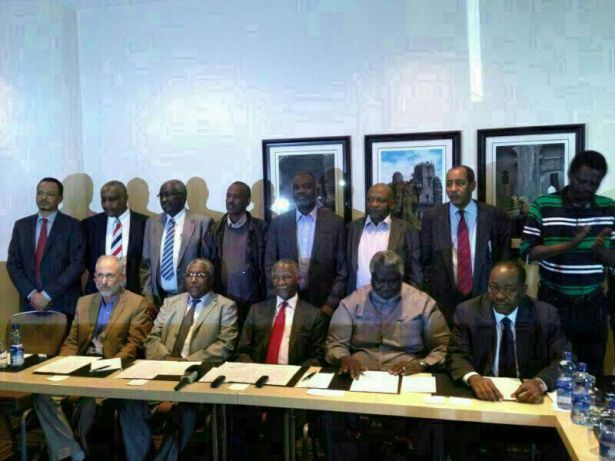
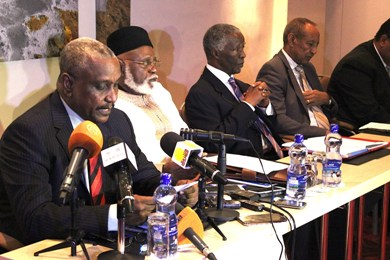
Sudanese president agreed to release opposition leader: Mbeki
September 10, 2014 (KHARTOUM) – The head of the African Union High Implementation Panel (AUHIP), Thabo Mbeki, said that Sudanese president, Omer al-Bashir, welcomed his efforts for a successful dialogue in Sudan and agreed to release jailed opposition leader Ibrahim al-Sheikh.)
Mbeki, following a meeting with Bashir on Wednesday, said that the Sudanese president welcomed the agreement on national dialogue and constitutional process inked by Paris declaration forces and the national dialogue subcommittee for external liaison in Addis Ababa on 4 September.
He further said the meeting addressed “the need to create the right climate” for conducting the national dialogue by allowing freedom of expression, assembly and information as well as releasing political prisoners and detainees.
“And indeed the president again agreed about t the importance of that. So he said to me that according to our discussions the government would take the necessary action to release Ibrahim al-Sheikh,” Mbeki said.
On Wednesday evening a spokesperson for the opposition Sudanese Congress Party (SCoP) told Sudan Tribune that they were not officially notified of a decision to release the party leader, pointing that al-Sheikh is being currently arrested in Al-Obeid prison, North Kordofan state along with six others party members.
The National Intelligence and Security Service (NISS) arrested al-Sheikh in June after comments he made at a seminar in which he criticised the Rapid Support Forces (RSF) and accused them of committing abuses in conflict zones. He faces charges that could hand him the death penalty if convicted.
On Monday evening, NISS released the deputy chairman of the opposition National Umma Party (NUP), Meriam al-Mahdi, who has been arrested upon her return to the country on 11 August after taking part in talks between the NUP and the rebel alliance of the Sudanese Revolutionary Front (SRF) in France.
BASHIR SUPPORTS INCLUSIVE DIALOGUE
Mbeki said he discussed with Bashir the need to make progress in the national dialogue process, pointing the latter emphasised for the need of an inclusive process, incorporating civil society and armed groups.
The head of the AUHIP further said the Sudanese president expressed his support to the agreement on national dialogue and constitutional process adding that the dialogue high committee known as 7+7 “will meet and look at the progress (achieved) and take all the necessary decisions about that”.
“So we will continue our effort to engage both the 7+7 and the others (Paris declaration forces) about how to take forward that particular document which they signed in Addis Ababa and again the president agreed we should do that,” he added.
African and Western diplomats had earlier confirmed to Sudan Tribune that Mbeki’s meeting with Bashir aims to hold an all parties conference in Addis Ababa next month to reach a framework agreement for the internal political process.
MBEKI TO BRIEF UNSC, AUPSC
Mbeki said he informed Bashir that he will present a briefing about these developments to the African Union Peace and Security Council (AUPSC) on Friday and will fly five days later to New York to meet with the United Nations Security Council (UNSC).
“We will be able to give a report both to the AUPSC and the UNSC about this development, and of course urging all of them to help us to address other matters like forgiving the external debit of Sudan,” he said.
The minister at Sudanese presidency, al-Rashid Haroon, told reporters following the meeting that Bashir welcomed the agreement because it did not contradict with the outcome of the 7+7 committee, pointing the government would have preferred to sign it inside Sudan.
“However, we don’t mind as long as it did not overstep what has been agreed upon by the 7+7 committee,” he added.
He stressed that dialogue will be conducted inside Sudan and with Sudanese will.
Haroon said that Mbeki, in his recent visit to Doha, discussed with Qatari deputy prime minister Ahmed bin Abdullah Al Mahmoud ways to involve the non-signatories in the comprehensive process on the basis of the Doha Document for Peace in Darfur (DDPD).
KHARTOUM, JUBA RELATIONS
The meeting between Bashir and Mbeki also discussed results of the latter’s recent visit to Juba.
The head of the AUHIP said he agreed with officials in South Sudan to hold a meeting for the joint security committee in Juba to look into implementation of pending issues between the two countries.
He said that Bashir agreed to meeting of the committee, pointing the issue will be further discussed with Sudan’s defence minister, Abdel-Rahim Mohamed Hussein.
(ST)
giovedì 11 settembre 2014
mercoledì 10 settembre 2014
martedì 9 settembre 2014
GOOD NEWS wait and see.
Embiki to Doha to persuade it to open a new path for negotiation
Rapid developments after the Addis Ababa agreement
09-09-2014 02:14 AM
London: Ammar Awad
Informed sources from the Qatari capital of Doha for the arrival of the delegation presented to the President of the African high-level Thabo Mbeki to the (Doha) while waiting for it to arrive Mbeki out there within the next two days, the sources said the visit aims to open a new path for negotiations on Darfur in Addis Ababa so that Mbeki that oversees the cessation of hostilities in Darfur to blue Nile.
The Revolutionary Front has placed several requirements, according to sources, the most important of it is bound to what has been of dialogue in Khartoum and that all parties should start on an equal footing in addition to the need to be a cessation of hostilities comprehensive from Darfur to Blue Nile, according to the source, who pointed out that the RUF told them as calling for a preparatory conference to be agreed around him on all procedures related to the constitutional process before the launch, noting that the RUF refused to exclude any party insists on the participation of the forces of national consensus and civil society organizations opposed to the government in addition to demanding a halt Adaúaat comprehensive and deliver humanitarian aid and allow freedoms before holding any constitutional process is known that any constitutional process of seeing revolutionary Front will lead to a comprehensive transitional arrangements according to the source.
It is expected to submit a report Thabo Mbeki for the Peace and Security Council of the African Day 12-9 also expected to present a similar report later this month to the UN Security Council.
In the Ethiopian capital, Addis Ababa, informed sources revealed that the leaders of the Revolutionary Front has completed a plan to unite the forces of the opposition in the cases of the success of the contract inclusive constitutional process or work to topple the regime.
Rapid developments after the Addis Ababa agreement
09-09-2014 02:14 AM
London: Ammar Awad
Informed sources from the Qatari capital of Doha for the arrival of the delegation presented to the President of the African high-level Thabo Mbeki to the (Doha) while waiting for it to arrive Mbeki out there within the next two days, the sources said the visit aims to open a new path for negotiations on Darfur in Addis Ababa so that Mbeki that oversees the cessation of hostilities in Darfur to blue Nile.
The Revolutionary Front has placed several requirements, according to sources, the most important of it is bound to what has been of dialogue in Khartoum and that all parties should start on an equal footing in addition to the need to be a cessation of hostilities comprehensive from Darfur to Blue Nile, according to the source, who pointed out that the RUF told them as calling for a preparatory conference to be agreed around him on all procedures related to the constitutional process before the launch, noting that the RUF refused to exclude any party insists on the participation of the forces of national consensus and civil society organizations opposed to the government in addition to demanding a halt Adaúaat comprehensive and deliver humanitarian aid and allow freedoms before holding any constitutional process is known that any constitutional process of seeing revolutionary Front will lead to a comprehensive transitional arrangements according to the source.
It is expected to submit a report Thabo Mbeki for the Peace and Security Council of the African Day 12-9 also expected to present a similar report later this month to the UN Security Council.
In the Ethiopian capital, Addis Ababa, informed sources revealed that the leaders of the Revolutionary Front has completed a plan to unite the forces of the opposition in the cases of the success of the contract inclusive constitutional process or work to topple the regime.
Did Bashir wants PEACE WE WILL WAIT AND SEE.
Sudanese security releases opposition NUP deputy leader
September 8, 2014 (KHARTOUM) – Sudan’s security service released deputy leader of the National Umma Party (NUP) Marriam al-Mahdi on Monday after nearly one-month of extra-judiciary detention following a meeting with rebel groups in the French capital.
Al-Mahdi had been arrested upon her arrival to Khartoum airport on 11 August after taking part in talks with the Sudanese Revolutionary Front (SRF) that led to the signing of Paris Declaration.
The opposition party announced late on Monday evening that the NUP vice-president was freed and released some pictures where she was appears hugging her family members.
She is also expected to hold a press conference on midday over the conditions of her detention.
Al-Mahdi did not face any charges and did not appear before a court. She was jailed at Omdurman Prison for women.
Following the signing of Paris Declaration which calls for a genuine national dialogue and the inclusion of rebel groups in the political process, the NUP leader Sadiq al-Mahdi returned to the Egyptian capital Cairo where he is based currently.
The National Congress Party (NCP) political secretary Mustafa Osman Ismail played down calls by some members of the ruling party to arrest al-Mahdi when he returns to the country.
Also, observers in Khartoum say the arrest of Marriam al-Mahdi embarrassed some leading figures in the ruling party as it and put in evidence the lack of coordination between the political and security apparatuses.
However others say no such move can be undertaken without a green light from president Omer al-Bashir.
(ST)
September 8, 2014 (KHARTOUM) – Sudan’s security service released deputy leader of the National Umma Party (NUP) Marriam al-Mahdi on Monday after nearly one-month of extra-judiciary detention following a meeting with rebel groups in the French capital.
Al-Mahdi had been arrested upon her arrival to Khartoum airport on 11 August after taking part in talks with the Sudanese Revolutionary Front (SRF) that led to the signing of Paris Declaration.
The opposition party announced late on Monday evening that the NUP vice-president was freed and released some pictures where she was appears hugging her family members.
She is also expected to hold a press conference on midday over the conditions of her detention.
Al-Mahdi did not face any charges and did not appear before a court. She was jailed at Omdurman Prison for women.
Following the signing of Paris Declaration which calls for a genuine national dialogue and the inclusion of rebel groups in the political process, the NUP leader Sadiq al-Mahdi returned to the Egyptian capital Cairo where he is based currently.
The National Congress Party (NCP) political secretary Mustafa Osman Ismail played down calls by some members of the ruling party to arrest al-Mahdi when he returns to the country.
Also, observers in Khartoum say the arrest of Marriam al-Mahdi embarrassed some leading figures in the ruling party as it and put in evidence the lack of coordination between the political and security apparatuses.
However others say no such move can be undertaken without a green light from president Omer al-Bashir.
(ST)
lunedì 8 settembre 2014
Sbiancamento della pelli !!!!!
Raggiungere «ragazze sudanesi stanno pagando a caro prezzo sbiancamento della pelle» solleva polemiche
2014/09/08 02:36
Salahuddin Mustafa
Khartoum: indagine ha trovato il sociale pubblicato «Quds Al-Arabi» intitolato «ragazze sudanesi stanno pagando a caro prezzo la pelle sbiancante» nel suo numero del cinquecentesco di agosto / Agosto alle reazioni e in largo tra i sudanesi schierato in paesi in tutto il mondo, e dopo essere stato trasferito e caricato «sito elettronicamente «Alrakubh» sudanese Alshahyr- attribuita a «Quds Al-Arabi» - ha ricevuto più argomenti leggere fino alla data odierna.
E aumentato il numero di persone che sono stati informati sullo studio di 70 mila e il numero di lettori che hanno commentato l'oggetto di più di 130 e di interazione Almtdakhalon è molto grande e questa interazione andare a molti siti di social networking, in particolare «Facebook».
L'indagine ha cominciato a spiegare il fenomeno ed è venuto nella sua introduzione «cambiamento di colore dal marrone al seguente white dietro una scala immaginaria di bellezza, è diventato un fenomeno nella società sudanese. Invece di portare questo processo è diventato ammirazione patetico e ridicolo, dove si trova il colore della faccia differisce mani per lo più di colore e le gambe. E diffondere piccoli negozi conosciuti colloquialmente come «le circostanze» e creme che vengono venduti con un cucchiaio, e la gravità di questo problema sta nel non essere in grado di vedere la scadenza del Santo o il tipo di aziende produttrici »!
Chiesto qualche discussione sovrapposizione di questo soggetto attraverso esperti Sociologia e psicologi per capire il fenomeno, e altri hanno chiesto che discute la croce parlamento «Parlamento», come riflette le preoccupazioni del lavoro circa l'identità del popolo sudanese, e attribuirono gli altri E 'dopo la politica e il deterioramento dei valori che richiedono i pilastri della vita sudanese.
Dice Hanan Ibrahim Jack, un attivista sociale e avvocato per le questioni femminili «sono indicati rappresentano stupido concetto grande e cultura molto superficiale di bellezza falsa e cultura prevalente nella nostra società sudanese ha stabilito per questa dimensione magra, che ha influito pesantemente sulla composizione delle donne sudanesi a causa dei concetti di superficie riflette la misura in cui le donne Sudan non ha i booster fiducia nella composizione estetica ».
E vai tenerezza che le donne sudanesi andare dopo di superficie che rappresenta la superficie della sua vista quando vuole lavorare in un posto di lavoro, perché gli standard sono sminuire le sue risorse e la ricerca di altre abilità, quindi è andato alla deriva violentemente in questo dilemma, che ha causato una scossa significativa psicologico in standard di bellezza delle donne sudanesi ».
E conclude che le donne nel nostro paese hanno fatto ricorso alla bellezza di pericoloso e perse da un senso di catastrofica, ad amare tutto ciò che è a rischio e minacciando la salute e qui un grande disastro per essere percepito dal cosciente, e osserva che tutti i titoli a livello del pensiero e della cultura e la consapevolezza Astrkin in questa materia, che si descrive come pericoloso. E c'è da stupirsi: per tutto questo? La risposta: l'uomo che è venuto per essere non piacergli bianco e conclude dicendo «ciò che più eclatanti essere il modello per le donne di strumenti che permettono di essere bello davanti alla comunità di non rispettare la sua mente e l'esistenza della femmina, ma visto come le dimensioni del sensoriale e pagare questo prezzo per le sue malattie stupidità non li può sfuggire, purtroppo».
Secondo uno Almtdakhalat come «luce» Il problema di fondo è la perdita di identità, perdita di fiducia in se stessi che subiscono le donne sudanesi e il razzismo che allattano per le nostre figlie fin dall'infanzia e chiede che ci sia un altro concetto di pensare al viso bellezza Fbaad non è tutto, come diceva lei, lei dice,
Calamity nell'ignoranza del educato come i medici Vtgdan «Mfssokhat» viso e stavano usando hennè colorante dove se la consapevolezza?
E ha colpito una luce in che il Sudan TV è il primo a guidare la campagna di ignoranza questa mostra annunciatori Whitawat solo, ed è del parere che questo non riflette la realtà del tessuto sociale di questo paese e chiede: «Perché non troviamo un emittente e uno del Sudan occidentale, per esempio, che non appaiono in TV Sudan, non importa che la competenza dei funzionari, il talento e la mente, ma sono interessati al colore bianco per confrontare con la televisione araba e, purtroppo, è completa ignoranza della identità sudanese con la mancanza di consapevolezza della salute, divenne il centro di una elevata percentuale di giovani donne malattie come l'insufficienza renale e tumori della pelle e di altri ».
Partecipa Abu Tutto nella discussione e dice «ti piace Alhbashaat Matzat Blonhen e Bbldhen, nonostante il fatto che il loro paese non li ha fornito con qualcosa, le nostre figlie Unità maledizione nel paese e la gente del paese e Ptstaml in creme Ahan spirito candeggio, penso che il progetto di civiltà e di canali sudanesi che non consentono solo la qualità del colore annunciatori apri o gli utilizzatori di creme sbiancanti e questo è il motivo ».
E ammonisce da ma io stesso inchiesta
«Psodani» Starter e dice «non è riuscita a mettere questo argomento nel giornale arabo diffusa, nonostante il fatto che si tratta di una realtà, ma dovrebbe ridurre lo scandalo a giornali dove locale non leggono gli arabi Athmkon noi e ci Taunt».
Dice Abu devo «dei punti salienti delle conseguenze che hanno portato all'imposizione della identità araba del Sudan per identificare i tratti e le caratteristiche di alcuni dei concetti e dei valori estetici umanità sulla base della identità araba, per esempio, dispone di belle donne in Sudan per essere di colore chiaro e gli occhi grandi e il suo pelo è lungo, e l'uomo di avere i capelli lisci (Sbibi ), come si dice, senza controllo nel colore della pelle ..
E imposto nei programmi di istruzione e di accettazione nella società
2014/09/08 02:36
Salahuddin Mustafa
Khartoum: indagine ha trovato il sociale pubblicato «Quds Al-Arabi» intitolato «ragazze sudanesi stanno pagando a caro prezzo la pelle sbiancante» nel suo numero del cinquecentesco di agosto / Agosto alle reazioni e in largo tra i sudanesi schierato in paesi in tutto il mondo, e dopo essere stato trasferito e caricato «sito elettronicamente «Alrakubh» sudanese Alshahyr- attribuita a «Quds Al-Arabi» - ha ricevuto più argomenti leggere fino alla data odierna.
E aumentato il numero di persone che sono stati informati sullo studio di 70 mila e il numero di lettori che hanno commentato l'oggetto di più di 130 e di interazione Almtdakhalon è molto grande e questa interazione andare a molti siti di social networking, in particolare «Facebook».
L'indagine ha cominciato a spiegare il fenomeno ed è venuto nella sua introduzione «cambiamento di colore dal marrone al seguente white dietro una scala immaginaria di bellezza, è diventato un fenomeno nella società sudanese. Invece di portare questo processo è diventato ammirazione patetico e ridicolo, dove si trova il colore della faccia differisce mani per lo più di colore e le gambe. E diffondere piccoli negozi conosciuti colloquialmente come «le circostanze» e creme che vengono venduti con un cucchiaio, e la gravità di questo problema sta nel non essere in grado di vedere la scadenza del Santo o il tipo di aziende produttrici »!
Chiesto qualche discussione sovrapposizione di questo soggetto attraverso esperti Sociologia e psicologi per capire il fenomeno, e altri hanno chiesto che discute la croce parlamento «Parlamento», come riflette le preoccupazioni del lavoro circa l'identità del popolo sudanese, e attribuirono gli altri E 'dopo la politica e il deterioramento dei valori che richiedono i pilastri della vita sudanese.
Dice Hanan Ibrahim Jack, un attivista sociale e avvocato per le questioni femminili «sono indicati rappresentano stupido concetto grande e cultura molto superficiale di bellezza falsa e cultura prevalente nella nostra società sudanese ha stabilito per questa dimensione magra, che ha influito pesantemente sulla composizione delle donne sudanesi a causa dei concetti di superficie riflette la misura in cui le donne Sudan non ha i booster fiducia nella composizione estetica ».
E vai tenerezza che le donne sudanesi andare dopo di superficie che rappresenta la superficie della sua vista quando vuole lavorare in un posto di lavoro, perché gli standard sono sminuire le sue risorse e la ricerca di altre abilità, quindi è andato alla deriva violentemente in questo dilemma, che ha causato una scossa significativa psicologico in standard di bellezza delle donne sudanesi ».
E conclude che le donne nel nostro paese hanno fatto ricorso alla bellezza di pericoloso e perse da un senso di catastrofica, ad amare tutto ciò che è a rischio e minacciando la salute e qui un grande disastro per essere percepito dal cosciente, e osserva che tutti i titoli a livello del pensiero e della cultura e la consapevolezza Astrkin in questa materia, che si descrive come pericoloso. E c'è da stupirsi: per tutto questo? La risposta: l'uomo che è venuto per essere non piacergli bianco e conclude dicendo «ciò che più eclatanti essere il modello per le donne di strumenti che permettono di essere bello davanti alla comunità di non rispettare la sua mente e l'esistenza della femmina, ma visto come le dimensioni del sensoriale e pagare questo prezzo per le sue malattie stupidità non li può sfuggire, purtroppo».
Secondo uno Almtdakhalat come «luce» Il problema di fondo è la perdita di identità, perdita di fiducia in se stessi che subiscono le donne sudanesi e il razzismo che allattano per le nostre figlie fin dall'infanzia e chiede che ci sia un altro concetto di pensare al viso bellezza Fbaad non è tutto, come diceva lei, lei dice,
Calamity nell'ignoranza del educato come i medici Vtgdan «Mfssokhat» viso e stavano usando hennè colorante dove se la consapevolezza?
E ha colpito una luce in che il Sudan TV è il primo a guidare la campagna di ignoranza questa mostra annunciatori Whitawat solo, ed è del parere che questo non riflette la realtà del tessuto sociale di questo paese e chiede: «Perché non troviamo un emittente e uno del Sudan occidentale, per esempio, che non appaiono in TV Sudan, non importa che la competenza dei funzionari, il talento e la mente, ma sono interessati al colore bianco per confrontare con la televisione araba e, purtroppo, è completa ignoranza della identità sudanese con la mancanza di consapevolezza della salute, divenne il centro di una elevata percentuale di giovani donne malattie come l'insufficienza renale e tumori della pelle e di altri ».
Partecipa Abu Tutto nella discussione e dice «ti piace Alhbashaat Matzat Blonhen e Bbldhen, nonostante il fatto che il loro paese non li ha fornito con qualcosa, le nostre figlie Unità maledizione nel paese e la gente del paese e Ptstaml in creme Ahan spirito candeggio, penso che il progetto di civiltà e di canali sudanesi che non consentono solo la qualità del colore annunciatori apri o gli utilizzatori di creme sbiancanti e questo è il motivo ».
E ammonisce da ma io stesso inchiesta
«Psodani» Starter e dice «non è riuscita a mettere questo argomento nel giornale arabo diffusa, nonostante il fatto che si tratta di una realtà, ma dovrebbe ridurre lo scandalo a giornali dove locale non leggono gli arabi Athmkon noi e ci Taunt».
Dice Abu devo «dei punti salienti delle conseguenze che hanno portato all'imposizione della identità araba del Sudan per identificare i tratti e le caratteristiche di alcuni dei concetti e dei valori estetici umanità sulla base della identità araba, per esempio, dispone di belle donne in Sudan per essere di colore chiaro e gli occhi grandi e il suo pelo è lungo, e l'uomo di avere i capelli lisci (Sbibi ), come si dice, senza controllo nel colore della pelle ..
E imposto nei programmi di istruzione e di accettazione nella società
sabato 6 settembre 2014
WAIT AND SEE ...... anglosaxone probnerb......!!!
Alrakubh unique signature of an agreement to publish dialogue committee 7 +7 representatives of the Paris Declaration and the testimony of President Thabo Mbeki
09-05-2014 01:31 PM
Alrakubh: Abdulwahab Hemmat
After constructive negotiations with a delegation of mediation under the auspices of the President of the dialogue mechanism President Thabo Mbeki and the mediation team in the Ethiopian capital Addis Ababa on the fifth of September 2014 AD was the dawn of the day Friday the fifth of Spettmbraltoukaa agreements set to dialogue committee 7 plus 7 and a declaration of Paris was signed for the first Dr. Ghazi Salah Eddin, head of the reform movement now, and Mr. Ahmed Saad Omar and witnessed the signing of President Thabo Mbeki Chairman of the dialogue mechanism
By another agreement was signed testament to the national dialogue and the process of constitutional construction and delegated representatives to sign on behalf of the Paris Declaration, Mr. Sadiq al-Mahdi of the Umma Party Chairman, Mr. Chairman Malik Agar Revolutionary Front.
It is worth mentioning that these parties have signed each of them individually hand. The parties agreed on the two agreements signed in the following:
First: a comprehensive political solution is the best option to resolve all the problems of Sudan
Second: stop the war and the declaration of a cease-fire and to address the humanitarian situation must be the highest priority in the operations to rebuild trust
Third, ensure freedoms and basic human rights and the release of political detainees and Almatkulaian convicts priority is to build confidence and create a communication
Fourthly, we must begin to dialogue and constitutional process after laying the groundwork, rules and procedures that will be under the dialogue.
Fifth: All the participants in the dialogue to them the freedom to express their attitudes and opinions
Sixth: dialogue must be according to a timetable agreed upon.
Seventh: Safeguards must be available for the implementation of the outputs of dialogue and Banna Oualdsturi
Eighth: the need for the participation of all parties to ensure reaching a national consensus
Delegated representatives of the Commission for 7 plus 7
Mr. Ahmed Saad Omar
Dr. Ghazi Salahuddin Atabani
Witnesses
President Thabo Mbeki
Head of GM's high-
And level of the African Union
African Union
Follow-up mechanism and the implementation of high-level
The second agreement was signed between the forces of the Paris Declaration and the testimony of President Mbeki
Agreement on the national dialogue and the constitutional process
After constructive negotiations with a delegation of mediation under the auspices of the President of the mechanism President Thabo Mbeki and the mediation team in the Ethiopian capital Addis Ababa on September 5, 2014 AD, the undersigned acknowledged as follows: -
First: a comprehensive political solution is the best option to resolve all the problems of Sudan
Second: stop the war and the declaration of a cease-fire and to address the humanitarian situation must be the highest priority in the operations to rebuild trust
Third, ensure freedoms and basic human rights and the release of political detainees and Almatkulaian convicts priority is to build confidence and create a communication
Fourthly, we must begin to dialogue and constitutional process after laying the groundwork, rules and procedures that will be under the dialogue.
Fifth: All the participants in the dialogue to them the freedom to express their attitudes and opinions
Sixth: dialogue must be according to a timetable agreed upon.
Seventh: Safeguards must be available for the implementation of the outputs of dialogue and constitutional Banna
Eighth: the need for the participation of all parties to ensure reaching a national consensus
Signed by representatives of all the forces of the Paris Declaration
Mr. Sadiq al-Mahdi head of the National Umma Party
Commander Air Chairman Malik Agar Sudanese Revolutionary Front
Testimony
President Thabo Mbeki
Chairman of the mechanism of high-
Level of the African Union
09-05-2014 01:31 PM
Alrakubh: Abdulwahab Hemmat
After constructive negotiations with a delegation of mediation under the auspices of the President of the dialogue mechanism President Thabo Mbeki and the mediation team in the Ethiopian capital Addis Ababa on the fifth of September 2014 AD was the dawn of the day Friday the fifth of Spettmbraltoukaa agreements set to dialogue committee 7 plus 7 and a declaration of Paris was signed for the first Dr. Ghazi Salah Eddin, head of the reform movement now, and Mr. Ahmed Saad Omar and witnessed the signing of President Thabo Mbeki Chairman of the dialogue mechanism
By another agreement was signed testament to the national dialogue and the process of constitutional construction and delegated representatives to sign on behalf of the Paris Declaration, Mr. Sadiq al-Mahdi of the Umma Party Chairman, Mr. Chairman Malik Agar Revolutionary Front.
It is worth mentioning that these parties have signed each of them individually hand. The parties agreed on the two agreements signed in the following:
First: a comprehensive political solution is the best option to resolve all the problems of Sudan
Second: stop the war and the declaration of a cease-fire and to address the humanitarian situation must be the highest priority in the operations to rebuild trust
Third, ensure freedoms and basic human rights and the release of political detainees and Almatkulaian convicts priority is to build confidence and create a communication
Fourthly, we must begin to dialogue and constitutional process after laying the groundwork, rules and procedures that will be under the dialogue.
Fifth: All the participants in the dialogue to them the freedom to express their attitudes and opinions
Sixth: dialogue must be according to a timetable agreed upon.
Seventh: Safeguards must be available for the implementation of the outputs of dialogue and Banna Oualdsturi
Eighth: the need for the participation of all parties to ensure reaching a national consensus
Delegated representatives of the Commission for 7 plus 7
Mr. Ahmed Saad Omar
Dr. Ghazi Salahuddin Atabani
Witnesses
President Thabo Mbeki
Head of GM's high-
And level of the African Union
African Union
Follow-up mechanism and the implementation of high-level
The second agreement was signed between the forces of the Paris Declaration and the testimony of President Mbeki
Agreement on the national dialogue and the constitutional process
After constructive negotiations with a delegation of mediation under the auspices of the President of the mechanism President Thabo Mbeki and the mediation team in the Ethiopian capital Addis Ababa on September 5, 2014 AD, the undersigned acknowledged as follows: -
First: a comprehensive political solution is the best option to resolve all the problems of Sudan
Second: stop the war and the declaration of a cease-fire and to address the humanitarian situation must be the highest priority in the operations to rebuild trust
Third, ensure freedoms and basic human rights and the release of political detainees and Almatkulaian convicts priority is to build confidence and create a communication
Fourthly, we must begin to dialogue and constitutional process after laying the groundwork, rules and procedures that will be under the dialogue.
Fifth: All the participants in the dialogue to them the freedom to express their attitudes and opinions
Sixth: dialogue must be according to a timetable agreed upon.
Seventh: Safeguards must be available for the implementation of the outputs of dialogue and constitutional Banna
Eighth: the need for the participation of all parties to ensure reaching a national consensus
Signed by representatives of all the forces of the Paris Declaration
Mr. Sadiq al-Mahdi head of the National Umma Party
Commander Air Chairman Malik Agar Sudanese Revolutionary Front
Testimony
President Thabo Mbeki
Chairman of the mechanism of high-
Level of the African Union
lunedì 1 settembre 2014
No Peace.... nothing forward.
Home
News Monday 1 September 2014
SPLM-N says AU failed to call for new round of negotiations with Khartoum
ArticleComments (0). Email PrintSave
--------------------------------------------------------------------------------
August 31, 2014 (KHARTOUM) – The Sudan people’s Liberation Movement-North (SPLM-N) has dismissed statements by a Sudanese official saying the rebel group had declined an invitation to resume peace talks aimed at ending conflict in the Two Areas.
SPLM-N secretary-general and chief negotiator speaks at the opening session of peace talks in the Ethiopian capital, Addis Ababa, on 13 February 2014 (Photo: AUHIP) Sudanese presidential assistant and head of the government negotiating delegation, Ibrahim Ghandour on Saturday said that the SPLM refused the resumption of negotiations.
However, SPLM-N spokesperson Mubarak Ardol decried these claims, stressing that all what they received from the African Union mediation was an invitation for a consultation meeting on the national dialogue.
“We reiterate that the African Union High Level Implementation Panel (AUHIP) did not call to hold a new round of talks between the SPLM-N and the National Congress Party (NCP) but extended an invitation to the Sudanese Revolutionary Front (SRF), as one organisation, and the president of the National Umma Party Mr. Sadiq al-Mahdi to meet them,” Ardol said.
The rebel official further said that Ghandour is displeased by this recognition, and regretted that such attempt to misinform the Sudanese people comes from the chief negotiator.
Rebel delegations are in Addis Ababa for consultation meetings with the African Union officials over the national dialogue and ways to consider their participation in this process.
Sudanese government officials announced their keenness to involve rebel groups in the dialogue process.
They said this participation can come after the signing of a peace agreement in separate talks in Addis and Doha. If the rebel refuse the first option they can directly join the internal process where they can discuss peace and constitutional reforms in the framework of the national dialogue conference.
In a roadmap proposed in April, the rebel SRF demands a cessation of hostility, and talks on a framework for this process outside Sudan. However, the government proposes they come inside the country with international guarantee.
Khartoum see that a permanent ceasefire agreement should be negotiated before peace talks and rejects the idea of a cessation of hostilities, saying it allows rebels to prepare for a new war.
It is not clear if the AUHIP will invite the government and SPLM-N to meet again after the suspension of talks last April.
During a recent visit to the Sudanese capital, AUHIP chief said he and Darfur joint mediator Mohamed Ibn Chambas would consult the Qatari government on a new approach agreed with the government over the inclusion of rebels in the national dialogue.
Sudanese officials emphasised that Mbeki’s role will be restricted to monitoring the inter-Sudanese process.
(ST)
Sudan says rebels rejected African Union invitation to resume talks on Two Areas
News Monday 1 September 2014
SPLM-N says AU failed to call for new round of negotiations with Khartoum
ArticleComments (0). Email PrintSave
--------------------------------------------------------------------------------
August 31, 2014 (KHARTOUM) – The Sudan people’s Liberation Movement-North (SPLM-N) has dismissed statements by a Sudanese official saying the rebel group had declined an invitation to resume peace talks aimed at ending conflict in the Two Areas.
SPLM-N secretary-general and chief negotiator speaks at the opening session of peace talks in the Ethiopian capital, Addis Ababa, on 13 February 2014 (Photo: AUHIP) Sudanese presidential assistant and head of the government negotiating delegation, Ibrahim Ghandour on Saturday said that the SPLM refused the resumption of negotiations.
However, SPLM-N spokesperson Mubarak Ardol decried these claims, stressing that all what they received from the African Union mediation was an invitation for a consultation meeting on the national dialogue.
“We reiterate that the African Union High Level Implementation Panel (AUHIP) did not call to hold a new round of talks between the SPLM-N and the National Congress Party (NCP) but extended an invitation to the Sudanese Revolutionary Front (SRF), as one organisation, and the president of the National Umma Party Mr. Sadiq al-Mahdi to meet them,” Ardol said.
The rebel official further said that Ghandour is displeased by this recognition, and regretted that such attempt to misinform the Sudanese people comes from the chief negotiator.
Rebel delegations are in Addis Ababa for consultation meetings with the African Union officials over the national dialogue and ways to consider their participation in this process.
Sudanese government officials announced their keenness to involve rebel groups in the dialogue process.
They said this participation can come after the signing of a peace agreement in separate talks in Addis and Doha. If the rebel refuse the first option they can directly join the internal process where they can discuss peace and constitutional reforms in the framework of the national dialogue conference.
In a roadmap proposed in April, the rebel SRF demands a cessation of hostility, and talks on a framework for this process outside Sudan. However, the government proposes they come inside the country with international guarantee.
Khartoum see that a permanent ceasefire agreement should be negotiated before peace talks and rejects the idea of a cessation of hostilities, saying it allows rebels to prepare for a new war.
It is not clear if the AUHIP will invite the government and SPLM-N to meet again after the suspension of talks last April.
During a recent visit to the Sudanese capital, AUHIP chief said he and Darfur joint mediator Mohamed Ibn Chambas would consult the Qatari government on a new approach agreed with the government over the inclusion of rebels in the national dialogue.
Sudanese officials emphasised that Mbeki’s role will be restricted to monitoring the inter-Sudanese process.
(ST)
Sudan says rebels rejected African Union invitation to resume talks on Two Areas
Iscriviti a:
Post (Atom)