SPLM-N: 'Sudan soldiers repulsed from Blue Nile outpost'
January 17 - 2017EL TADAMON
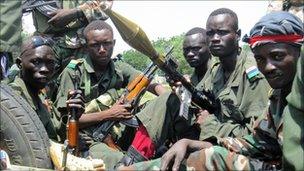
A Sudan People's Liberation Movement-North rebel soldier looks out toward Talodi in South Kordofan (AFP)
The Sudan People's Liberation Movement-North (SPLM-N) repulsed Sudanese soldiers and militiamen from an outpost in Alrum, Blue Nile, on Monday morning.
The movement's spokesman stated that the raid resulted in wounding a rebel fighter. They were unable to verify casualties from the government's side.
“The raid is just hours after the ruling National Congress Party declared a so-called extension of a ceasefire for six months,” the short press statement concluded. President Omar Al Bashir announced the extension of the unilateral ceasefire for the Darfur region and South Kordofan and Blue Nile on Sunday.
The ceasefire extension is not the first in its kind as both Al Bashir as the armed movements extended their cessation of hostilities several times throughout 2016. The rebels have accused the Sudanese military of violating Al Bashir's ceasefire more than once.
Last week, the SPLM-N claimed that its forces came under attack by the Sudanese army in the same area in El Tadamon locality, but that the fighting subdued after they repulsed the military forces.
Help
us as Fung Association and donate 5 dollars to build school for the
displaced persons victim of civil war in South Blue Nile through our
Fung Association representitive Abdelazim GomaaIBAN CODE
IT31R0760101600001040808527 Code BIC/SWIFT BPPIITRRXXX
CIN RABI 07601 CAB 01600 N. of account 1040808527
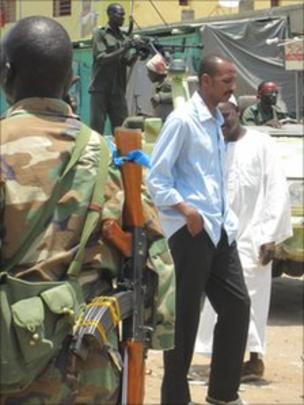
Image captionSoldiers patrol Damazin market and traders say there are "no problems"
The capital of Sudan's Blue Nile state, Damazin, is firmly under the control of the government - this is made clear by the soldiers ululating a victory song from next to their truck-mounted machine guns.
In Damazin, at least, the government soldiers seemed to have defeated rebels loyal to the opposition SPLM-North party in last week's fighting.
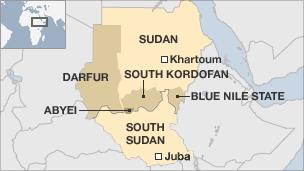
The rebels are now largely grouped in the south around their traditional stronghold, Kurmuk, with battles continuing along a shifting front line.
But burned by previous criticism for denying access to the similar conflict in the neighbouring state of South Kordofan, the Sudanese government brought journalists to Damazin for a controlled tour.
'Back to normal'
The state governor, and other authorities, were keen to stress life in Damazin was getting back to normal.
Gen Yahia Mohamed Kheir was appointed by President Omar al-Bashir after he called a state of emergency in Blue Nile, and sacked the elected governor, Malik Agar.
Mr Agar is the head of the SPLM-North party - and the man now leading the rebels in the state.
Many of them fought with the SPLM during Sudan's long north-south conflict, which resulted in July's SPLM-led independence for South Sudan, but they now find themselves north of the new international border.
"The security situation is very good, electricity, the hospitals and water are fine," the new governor Gen Kheir said.
He announced the number of deaths in Damazin in the fighting had not been in the hundreds - he put the total at 12 dead soldiers, six policemen and three civilians, as well as an unspecified number of rebels.
But he admitted clashes were continuing 30km (20 miles) south of Damazin.
I pressed him on claims made by SPLM-North and refugees who have fled to Ethiopia that civilians had been killed by aerial bombardments in Kurmuk and elsewhere in the last few days.
"We have never seen a single civilian killed in those bombardments, if there are any," he said.
Jumpy soldiers
It certainly wasn't easy to ascertain the effects of the fighting in Damazin either.
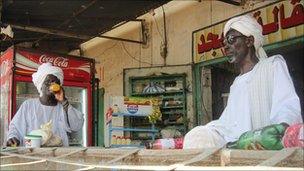
Image captionSudanese authorities are keen to show that day-to-day activities have been resumed
We weren't taken to the former governor's house, which allegedly came under attack, or to any places bearing obvious battle scars.
But the soldiers were clearly jumpy.
We travelled in a convoy of 4x4s, many of them carrying armed men, with a couple of trucks armed with machine guns - technicals they are sometimes called.
When one journalist tried to take a picture of a soldier out of the window, we heard the rapid and ominous clicks of several guns being cocked at once and our bus was made to stop.
When we arrived in a market, crowds gathered round the state minister we were travelling with, chanting Allahu akbar - God is great! - and pointing their right index fingers to the sky.
The traders insisted everything was fine, and normal - "no problems" they all said.
But many of the market stalls were shut down - a fact not entirely explained by the recent Eid al-Fitr holiday marking the end of Ramadan.
Large numbers of people have clearly fled the town.
"On Friday there was lots of fighting, in many places," one young man said, as one of our minders hovered nearby.
"You know the people all moved out, because of the war.
"I see on the road people are coming back, life is normal now, there are no problems."
Army tour
The authorities were also keen to show us the objects they said they had captured during the fighting, so they took us for a rare visit inside an army barracks.
Inside a walled compound about 80 prisoners sat on the ground, mainly staring sullenly in front of them.
In the middle, on the sandy floor, was a collection of guns, membership forms for the SPLM, photo albums, military epaulettes, SPLM constitutions, South Sudanese currency and even packets of condoms, perhaps particularly shocking in a relatively conservative Muslim society.
The army says they seized all this material during the clashes.
They also presented us several officers wearing SPLA uniforms.
That means they fought with the rebels who recently won independence for South Sudan, but as northerners were stranded here when South Sudan seceded in July.
Their presence, in Southern Kordofan and Blue Nile, is at the heart of the conflicts in the two states.
Colonel Omer Abdel Beyin Omer Maki said he hadn't wanted to join this latest conflict, and was being well treated by the Sudanese army.
An army officer stood by while he talked, listening intently.
Sudan accuses South Sudan of supporting the rebels in South Kordofan and Blue Nile. The new nation denies the charges. But there is no doubt all this is further poisoning the relationship between the two states.
As we left the barracks a new prisoner was brought in.
He looked dishevelled. A soldier ran up and slapped him.
This drew an immediate, shouted, condemnation from a nearby officer, perhaps aware of the presence of journalists, or maybe concerned that the right thing be done.
What next?
One thing I hoped to learn from a day in Damazin was what is likely to happen next.
Image captionSudan army officers gave the journalists a rare tour of their barracks
The governor refused to discuss whether his troops were preparing to push on down to Kurmuk, though this is perhaps unlikely in the difficult conditions of the rainy season.
A paramount chief from the area, Youssef al Mak Youssef Hassan Adan, said he believed reconciliation was still possible.
"Both sides may sit peacefully and settle their dispute. I hope that they will think it over, and put down their arms, and we can sit together," he said.
But when he made just that point in a town hall meeting he was shouted down by those present, mainly local notables.
In Damazin, days after a war broke out here and elsewhere in Blue Nile, any talk of peace seems premature.
Help us as Fung Association and donate 5 dollars to build school for the displaced persons victim of civil war in South Blue Nile through our Fung Association representitive Abdelazim GomaaIBAN CODE IT31R0760101600001040808527 Code BIC/SWIFT BPPIITRRXXX CIN RABI 07601 CAB 01600 N. of account 1040808527
Help us as Fung Association and donate 5 dollars to
build school for the displaced persons victim of civil war in South Blue Nile through our Fung Association representitive Abdelazim GomaaIBAN CODE IT31R0760101600001040808527 Code BIC/SWIFT BPPIITRRXXX CIN RABI 07601 CAB 01600 N. of account 1040808527
Blue Nile state: Basic school exams resume after 20 years
March 7 - 2018EL KURMUK / EL DAMAZIN
A school class in Yabous, Blue Nile state (File photo)
On Tuesday, 103 students sat for the basic school examination in El Kurmuk, a town on the border of Sudan’s Blue Nile state with Ethiopia. It is the first time students in the area have taken the exam since 1998.
At the same time, 135 nomadic students sat for the basic school exam at El Zahraa school in the state capital of El Damazin.
In a statement following the exam sessions, Deputy Governor Abdelrahman Bilal Beleid said that “these students sitting for the basic exams are evidence of the expansion of security and peace in Blue Nile”.
In his statement, the deputy governor said that “the presence of children of nomads and returnees in the examinations confirms the state government’s interest and keenness to create a school environment for all segments of the state”.
Inaccessible
Continuous conflict and displacement in the area left it isolated and inaccessible to aid agencies for many years. In April 2017, the United Nations Children’s Fund (Unicef) was granted access to a few hard-to-reach areas including El Kurmuk.
The UN Office for the Coordination of Humanitarian Affairs (OCHA) in Sudan reported in its humanitarian bulletin that Unicef began working with government authorities, state officials and partners to bring long overdue assistance, including child protection, education, health, nutrition, water and sanitation services to the vulnerable communities in the newly reached areas.
In Blue Nile State, Unicef, through the State Ministry of Health (SMoH) managed to assign additional staff to El Kurmuk hospital and provided health centres with medical supplies enough for two-months. In addition to two mobile clinics that serve about 15 villages Unicef—in coordination with SMoH—plans to train 100 healthcare providers and community health workers, including midwives. Through Unicef support, the SMoH conducted training for 16 nutrition care providers and established four supplementary feeding programmes.
Unicef
Unicef is also assisting in the rehabilitation and construction of 10 schools in these areas and will provide school supplies, benefitting 2,855 children. Aid organisations—with Unicef support—distributed chlorine tablets in Dindiro town for household water treatment, and installed two water bladders (with a capacity of 10,000 litres each). This is in addition to 260 barrels of water to that are trucked in daily, benefitting 10,000 people in the town. In Dindiro, El Kurmuk town, Jurut East, Jurut West and Bulang, Unicef, IRW and WES have started rehabilitating 20 hand pumps.
There were also 105 separated and unaccompanied children in Bulang, Dindiro, Jurut East, Jurut West and El Kurmuk town who received assistance. The children were placed with families—who were trained on alternative care measures and psychosocial support—and were provided with plastic sheets and sitting mats. The children were also provided with birth registration services and medical insurance.
Help us as Fung Association and donate 5 dollars to build school for the displaced persons victim of civil war in South Blue Nile through our Fung Association representitive Abdelazim GomaaIBAN CODE IT31R0760101600001040808527 Code BIC/SWIFT BPPIITRRXXX CIN RABI 07601 CAB 01600 N. of account 1040808527
Sudanese NISS release senior opposition leadersSudan's National Intelligence and Security Services (NISS) on Saturday night released eight opposition leaders who have been in detention since the beginning of the year. The eight include the spokesman of the Sudanese Communist Party Fathi Fadul, lawyer and former judge Mohammed al-Hafiz, and Sudanese Republican Party political secretary Haidar al-Safi. The NISS arrested more than 60 political detainees after opposition parties organised peaceful protests over rising prices of basic goods in January. Many more still remain in detention including the Sudanese Communist Party secretary Mohamed Mokhtar Al-Khatib.
Humiliation For Leather, For Law And Others
Humiliation for skin, by law and others
03-19-2018 04:13 PM
Salma Tijani
(1)
the parameter observed during the switching of children's clothing, inpreparation for the share of sports in one of the schools in the United Kingdom, there are signs on the body of one of the girls of Sudanese origin, taken after the end of the quota, and after having reassured, said the girl his mother punished by beatings. Because her mother knew she beat her in Britain, for young and old criminals, she was eager to be in hard-to-see places. After the incident that brought the student murder weapon (which was Mfrakh) after he hid inside her, sending her mother to a court, where she was forced to apologize to her child and pledged to ascribe, she must not be repeated, otherwise the law requires the disarming of the child from his parents and sent to live in a place where respect for their dignity. Britain, like Western countries, has criminalized the skin as a punishment and has disappeared from its laws since the 1970s.
In an Ortala incident in downtown Darfur, last week, as the back of the medium-speed rolling video, was the skin of the village men, without trial, and in a degrading way the waste of human dignity, and the consolidation of the 'humiliation of the citizen and stripped of all his rights guaranteed to him the interim establishment and interpreted by the laws. This happened during the arms collection campaigns in the area by government forces. Video ri Ortala to talk about the Kaaoukbh skin minds, and how he found his way to the Sudanese criminal laws, until reaching today's stage to be practiced without law and scruples of consequence.
(2)
(Islam is not used to accelerate the punishment, but the work to remove them by removing the causes) of the
Islamic thinker Rashid Ghannouchi, commenting whipping
given the skin the Sudan criminal laws, which was present in the first law (1889), which was followed within the year (1925), in order to avoid the provisions of the post-independence penal code enacted in 1974, which became a punishment alternative to sign as a passport.
Throughout this legislation confined to men flogging, until September's laws came in 1983 to restore the death penalty for men and women -specific and the number of its whipping tools from 25-100 lashes. So this law became the basis of Sudan's criminal law, in 1991, in which the death penalty exceeded the three legitimate border crimes, leading to sign the skin on more than thirty crimes, to become the worst law passing sanctions against Sudan since the nineteenth century. As the legislator decided that, in the twentieth century (the moment of enactment of the law) and in a world where more than most of the countries of the civil world Flogging, he saw that this people is not able to live only Whips on the back.
The government has not only, the penal code in 1991, humiliating people
through the signature of flogging in articles (151_ 156) contained in the door offered and public morality and crimes of reputation, and did not satisfy their desire to degrade human dignity Sudanese condemned the flogging according to loose texts where the estimates are left to the the mood of a policeman The prosecutor, the prosecutor and the judge, but three years ago, Saif imposed Article 67 of the law (riot crime) to whip the political act. It held that every rally of five or more people in violation of public peace, and is punishable by imprisonment or a fine or flogging of twenty lashes, surpassing the judge, usually, the first two options that is sentenced whipping, as it happened in 2015, when the members of a political party flogging were punished, for carrying out a mass confrontation One of the markets So, the criminal law jumped to exert its hold on the peaceful political activity and the worst punishments were an insult to humanity.
(3)
in 1997, the UN High Commissioner's punishment for corporal punishment was cruel, inhuman and degrading and the amount to be tortured, and therefore Flogging was incompatible with the Convention against Torture (Sudan is still reluctant to ratify it), and two years ago called for a commission of Saudi Arabia Saudi Arabia to stop corporal punishment such as amputation and scourging.
Here is the question: does Sudan not ratify the Convention against Torture, does it give it the right to swim contrary to current global human rights law? We live in an isolated island governed by a regime that has rebelled against international institutions and their families
Sudan News Umiliazione per pelle, per legge e altri
Umiliazione Per Pelle, Per Legge E Altri
03-19-2018 04:13 PM
Salma Tijani
(1)
il parametro osservato durante la commutazione dei vestiti dei bambini, inpreparazione per la quota di di sport in una delle scuole del Regno Unito, ci sono segni sul il corpo di uno dei ragazze di origine sudanese, presi dopo la fine della quota, e dopo aver rassicurato, ha detto la ragazza che sua madre punita da percosse. Perché la madre sapeva che le percosse in Gran Bretagna, per giovani e vecchi criminali, lei era desiderosa di essere in posti difficili da vedere. Finito l' incidente che ha portato l' arma studente omicidio ( che era Mfrakh) dopo ha nascosto dentro di lei, l'invio di madre a un tribunale, dove fu costretto a chiedere scusa al suo bambino e si è impegnato ascrivere, non deve essere ripetuto, altrimenti la legge richiede il disarmo del bambino dai suoi genitori e mandati a vivere in un luogo dove il rispetto per la loro dignità. La Gran Bretagna, come i paesi occidentali, ha criminalizzato la pelle come una punizione ed è scomparsa dalle sue leggi dagli anni '70. In un incidente Ortala nel centro Darfur, la scorsa settimana, come la parte posteriore del video di rotolamento media media, è stata la pelle del villaggio gli uomini, senza processo, e in un modo degradante lo spreco di dignità umana, e il consolidamento deldell'umiliazione del cittadino e spogliato di tutti i suoi diritti garantiti a lui laCostituzione ad interim e interpretati dalle leggi. Ciò è accaduto durante le campagne di raccolta di armi nell'area da parte delle forze governative. Video ri Ortala a parlare le menti della pelle Kaaoukbh, e come ha trovato la sua strada per le leggi penali sudanesi, fino a raggiungere la tappa di oggi ad essere praticata senza legge e scrupoli della conseguenza.
(2)
(l'Islam è , non serve per accelerare la punizione, ma il lavoro per rimuoverli dairimuovendo le cause) del pensatore islamico Rashid Ghannouchi , commentando fustigazione
dato la pelle le leggi penali sudanesi, che era presente nella prima legge (1889), che è stata seguita entro l'anno (1925), Al fine di evitare le disposizioni del codice penale post-indipendenza emanato nel 1974, che divenne una punizione alternativa da firmare come passaporto. In tutta questa legislazione confinato a uomini fustigazione, fino a quando le leggi di settembre è venuto nel 1983 per ripristinare la pena di morte per gli uomini e le donne -specifici e il numero dei suoi frustate utensili da 25-100 ciglia. Quindi questa legge divenne la base del diritto penale del Sudan, nel 1991 , in cui la pena di morte ha superato i tre reati di frontiera legittimi, portando a firmare la pelle su più di una trentina di reato, per diventare la legge peggiore che passa le sanzioni nei confronti del Sudan in quanto il diciannovesimo secolo. Come il legislatore ha deciso che, nel il XX secolo (il momento della promulgazione della legge) e in un mondo in cui più che la maggior parte dei paesi del mondo civile Flogging, egli vide che questo popolo è non in grado di vivere solo Fruste sulla la schiena. Il governo ha non solo, il codice penale nel 1991 , la gente umilianti attraverso la firma di fustigazione in articoli (151_ 156) contenuti nel la porta offerta ela morale pubblica e crimini di reputazione, e non soddisfacevano la loro volontà di degradare la dignità umana sudanese ha condannato lo fustigazione secondo a testi sciolti dove le stime sono lasciati al l' umore di un poliziotto Il pubblico ministero, il pubblico ministero e il giudice, ma tre anni fa, Saif ha imposto l'articolo 67 della legge (crimine antisommossa) per sferzare l'atto politico. Essa ha dichiarato che ogni raduno di cinque o più persone in violazione della quiete pubblica, ed è punibile con la reclusione o una multa o la fustigazione di venti frustate, superando il giudice, di solito, le prime due opzioni che è condannato fustigazione, come è accaduto nel 2015, quando sono stati puniti i membri di una fustigazione partito politico, per lo svolgimento adaffrontare una massa Uno dei mercati Quindi, la legge criminale saltò per esercitare la sua presa sull'attività politica pacifica e le peggiori punizioni erano un insulto per l'umanità.
(3)
nel 1997, classificati alla punizione corporale Alto Commissariato delle Nazioni Unite punizioni crudeli, disumane e degradanti e l' importo da torturati, e quindi è statoconsiderato Flogging incompatibile con la Convenzione contro la tortura (Sudan è ancora riluttante a ratificarlo), e due anni fa ha chiamato per una commissione del l'Arabia Nazioni Unite Arabia Saudita per fermare le punizioni corporali come l'amputazione e la flagellazione. Ecco la domanda: il Sudan non ratifica la Convenzione contro la tortura, gli dà il diritto di nuotare contrariamente alle attuali leggi globali sui diritti umani? Viviamo in un'isola isolata governata da un regime che si è ribellato alle istituzioni internazionali e alle loro leggi per torturare e umiliare la dignità dei cittadini? La comunità internazionale sta osservando le leggi disumane di un governo canaglia? Questo è per quanto riguarda la legge, ma circa l' umiliazione delle persone (Zndah) come è successo di recente in Ortala, si pratica ha cominciato lì, e come sistema di solito in impulsi, non si fermerà, vedremo uomini e donne Estendere sulla pancia sulla terra a Khartoum, civile e Atbara e altri, Sajldon nelle piazze Senza ragioni o violazione della legge, e poi scappare lasciando la loro umanità e dignità. "Se le condizioni umane vengono imposte in condizioni disumane e non si ribellano, perderà gradualmente la sua umanità", afferma Ernesto Che Guevara.




 Sudan's National Intelligence and Security Services (NISS) on Saturday night released eight opposition leaders who have been in detention since the beginning of the year.

